

Trap-Jaw Ants: How the Fastest Jaws in the Animal Kingdom Work
Trap-Jaw Ants: How the Fastest Jaws in the Animal Kingdom Work
I'm Anthony Prothero, the founder of Stateside Ants. Every so often a video of a trap-jaw ant goes around and somebody asks me whether the numbers in it are real. They usually are, and the mechanism behind them is stranger than the videos let on.
So here's how a trap-jaw ant works, what the research has measured, and what it takes to keep one.
What is a trap-jaw ant?
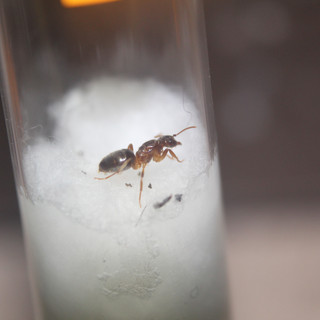
Trap-jaw ants hold their mandibles locked wide open and release them in a strike too fast to see. The name usually refers to the genus Odontomachus, though the same trick shows up elsewhere in other genera.
The jaws do two jobs. They catch prey, and they throw the ant through the air.
The numbers
Patek and colleagues (2006) put Odontomachus bauri under a high-speed camera and measured the strike.
Average closing speed was 38.4 meters per second, with peak speeds between 35.5 and 64.3 m/s. The top of that range is about 144 miles per hour. The strike takes somewhere between 0.13 and 0.5 milliseconds depending on the species and how it's measured, with the shortest recorded closure for O. bauri at about 0.3 ms (Gronenberg 1995a).
The force is more impressive than the speed. The strike generates peak forces of roughly 371 to 504 times the ant's own body weight. A later study on Odontomachus monticola measured angular accelerations on the order of 10^8 radians per second squared (Wang et al. 2022).
For scale: this is one of the fastest movements recorded in any animal, produced by an insect a few millimeters long.
Muscle can't do this
Muscle has a hard speed limit. A muscle fiber can only shorten so fast, and no amount of evolutionary pressure gets a muscle to contract at 140 miles per hour. If the trap-jaw strike were a very strong bite, it would be impossible.
So the ant loads a spring and releases a latch.
The system has three parts:
The spring. The ant contracts an enormous closer muscle, which fills much of the head capsule. That contraction doesn't move the mandibles, because they're locked. Instead the energy gets stored elastically, in the apodemes (the tendon-like structures the muscle pulls on), in the cuticle of the head itself, and in the muscle. The head is wound up like a spring, and this happens several seconds before the strike (Gronenberg 1995b).
The latch. Something has to hold the mandibles open while all that force builds. Work using X-ray micro-CT and live synchrotron imaging on Odontomachus kuroiwae identified fine structures at the mandibular joint forming a ball-joint arrangement with projections that catch and hold (Aonuma et al. 2023). That same study measured the closing mandible at an angular velocity of 2.3 × 10^4 radians per second (about 220,000 RPM).
The trigger. Long sensory hairs project from the inner face of the open mandibles. When prey touches one, a separate small trigger muscle releases the latch (Gronenberg 1995b). The stored energy dumps all at once.
Engineers call this arrangement latch-mediated spring actuation. A crossbow works the same way. You load it slowly with your arms, the catch holds the energy, and the trigger releases it far faster than your arms could ever have moved the string.
The reflex arc from trigger hair to release is fast enough that the ant isn't deciding to strike in any meaningful sense. The hair is touched and the jaws fire.
The ant as ammunition
If a trap-jaw ant fires its mandibles against the ground, or against a hard object, the force is so much that the ant launches.
Patek and colleagues (2006) documented two versions of this. In the escape jump, the ant points its jaws straight down and fires, sending itself vertically upward. In the bouncer defense, it strikes an intruder and both parties go flying in opposite directions.
An ant that weighs a few milligrams can throw itself several centimeters up and multiple body lengths sideways. This can be useful to escape bad situations!
Does the jumping help?
Larabee and Suarez (2015) noticed that Odontomachus brunneus in central Florida forage across sandy ground full of antlion pits. An antlion sits buried at the bottom of a conical sand trap and grabs whatever slides in.
They dropped ants into pits with antlions and watched what happened across 117 situations. The ants almost always tried to run first. The jump was what they fell back on when running failed, and it got them out of the pit about 15 percent of the time. Some jumps sent the ant further down the slope toward the antlion. Not ideal!
Then they ran a separate experiment, gluing the mandibles shut on a portion of the ants so they could still struggle but couldn't jump. Restraining the mandibles cut survival in half.
So the jump is not a reliable escape. It works roughly one time in seven. But a last-resort move that works one time in seven still doubles your odds of walking away, which is a decent return on a mechanism you already had for other reasons!
The sequence is what makes this good biology. The jaws almost certainly evolved for catching fast or dangerous prey, and then the jumping came afterward, as a reuse of a mechanism built for something else, because it sometimes helped out. That's the kind of stuff I love to see!
It evolved more than once
Trap jaws have appeared independently at least four separate times in ants (Larabee and Suarez 2014). Once in Ponerinae (Odontomachus and Anochetus), once in Formicinae (Myrmoteras), and at least twice in Myrmicinae (Strumigenys, plus at least once more in the group with Daceton and Acanthognathus)
That's considered a strong indicator that the trap jaw is a good answer to a specific problem: how does a small predator catch prey faster than itself, or subdue something dangerous before it can respond.
Odontomachus isn't the record holder
The fastest known animal appendage belongs to the Dracula ant, Mystrium camillae, which uses a different mechanism. Its jaws start closed, not open. It presses the mandible tips together and loads them against each other until one slips past the other, the way you'd snap your fingers. The strike completes in as little as 23 microseconds at peak speeds of 90 meters per second, over 200 miles per hour (Larabee et al. 2018).
So Odontomachus has the second-fastest predatory appendage in the animal kingdom. Still not bad!
Trap-jaw ants in the United States
You don't have to go to the tropics for these. These days there are 6 that are worth knowing:
Odontomachus brunneus is the one most people encounter. It occurs throughout most of Florida and into southern Georgia and Alabama, in both well-drained and poorly drained habitat, nesting in soil or rotten wood. It's the species most of the research above was done on.
Odontomachus clarus is the western species, found in the arid southwest.
Odontomachus desertorum is the slightly larger, desert-specialist from the southwest. Not much is known about these.
Odontomachus relictus is the interesting one. Deyrup and Cover described it in 2004 from scrub and sandhill on central Florida's ancient sand ridges, and it looks to be a Pleistocene relict, left behind on islands of dry habitat. Later work (MacGown et al. 2014) found that populations on separate ridges differ in both behavior and genetics, raising the possibility that they represent more than one species. If that turns out to be right, they would be among the rarest ants in North America. The habitat they depend on is itself endangered, constantly being developed and destroyed.
Odontomachus ruginodis and Odontomachus haematodus are both introduced and both spreading in the southeast. Haematodus is larger and more aggressive than the natives, which is worth watching.
What it's like to keep them
Trap-jaw ants are not a beginner species, and the reasons are specific.
They sting, and it hurts. Odontomachus has a functional sting and it's a real one. This is not a Camponotus where the worst case is a pinch and a squirt of formic acid.
Colonies stay small. Captive colonies typically top out in the low hundreds of workers. If you want a colony that fills a nest, this isn't it. What you get instead is a small group of large, striking predators you can watch individually.
Development is slow. Colonies don't grow very quickly.
They can be very finnicky. Beginners might have a hard time getting a decent setup right for them.
They benefit from substrate. Sometimes, beginners who aren't aware of this watch their colony fizzle out unknowingly.
They aren't considered very difficult ants, in our opinion. They're totally keepable! Just probably not the best for a beginner. Get acquainted with a few other ant colonies first, before you try your hand with these!
If you are keeping them and you have a proper setup, you'll want to get these things right: heat, humidity, substrate, food. Most Odontomachus want to be kept warm, in the 80s. Most of them want a humid nest. The southwestern ones (clarus and desertorum) may be different, but will probably still enjoy a humid nest. They typically need substrate to grip things easily and for their brood development. As for food, they're primarily predatory. Just like any other ants, overfeeding is always better than underfeeding, especially as the colony grows larger. Give them protein like crickets, roaches, etc.
References
Aonuma, H., Naniwa, K., Sugimoto, Y., Ohkawara, K., and Kagaya, K. (2023). Embodied latch mechanism of the mandible to power at ultra-high speed in the trap-jaw ant Odontomachus kuroiwae. Journal of Experimental Biology 226: jeb245396.
Deyrup, M. and Cover, S. (2004). A new species of Odontomachus ant (Hymenoptera: Formicidae) from inland ridges of Florida, with a key to Odontomachus of the United States. Florida Entomologist 87: 136-144.
Gronenberg, W. (1995a). The fast mandible strike in the trap-jaw ant Odontomachus. I. Temporal properties and morphological characteristics. Journal of Comparative Physiology A 176: 391-398.
Gronenberg, W. (1995b). The fast mandible strike in the trap-jaw ant Odontomachus. II. Motor control. Journal of Comparative Physiology A 176: 399-408.
MacGown, J.A., Boudinot, B., Deyrup, M., and Sorger, D.M. (2014). A review of the Nearctic Odontomachus (Hymenoptera: Formicidae: Ponerinae) with a treatment of the males. Zootaxa 3802(4): 515-552. doi:10.11646/zootaxa.3802.4.6
Larabee, F.J. and Suarez, A.V. (2014). The evolution and functional morphology of trap-jaw ants (Hymenoptera: Formicidae). Myrmecological News 20: 25-36.
Larabee, F.J. and Suarez, A.V. (2015). Mandible-powered escape jumps in trap-jaw ants increase survival rates during predator-prey encounters. PLOS ONE 10: e0124871.
Larabee, F.J., Smith, A.A., and Suarez, A.V. (2018). Snap-jaw morphology is specialized for high-speed power amplification in the Dracula ant, Mystrium camillae. Royal Society Open Science 5: 181447.
Patek, S.N., Baio, J.E., Fisher, B.L., and Suarez, A.V. (2006). Multifunctionality and mechanical origins: ballistic jaw propulsion in trap-jaw ants. Proceedings of the National Academy of Sciences 103: 12787-12792.
Wang, Z., Zhan, Y., Yang, Y., and Wu, J. (2022). Hollow mandibles: structural adaptation to high-speed and powerful strike in the trap-jaw ant Odontomachus monticola. Journal of Insect Physiology 141: 104426.
If you want to talk about trap-jaws or other ants with other keepers, join the Stateside Ants Discord.
If you're interested in getting started with an ant colony today, see here!


Comments