

You Caught a Lasius Queen This Fall. Now What?
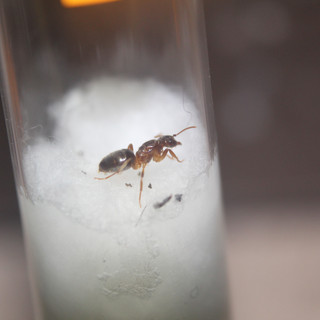

I'm Anthony Prothero, the founder of Stateside Ants. Every September and October my inbox fills up with the same message: somebody found a queen on their driveway, put her in a test tube, and now she's sitting there doing absolutely nothing.
The good news is, that's exactly what she's supposed to be doing!
Fall is the biggest flight season of the year for Lasius in most of the country, and it catches new keepers off guard because almost everything written about founding queens assumes a spring or summer catch. A queen caught in June starts laying in a few days. A queen caught in late September usually won't lay a single egg until spring, and keepers who DON'T know that spend the whole winter convinced that they're doing something wrong.
Here's what to do instead!
First, get her into a test tube
Before anything else, you have to set her up properly. Fill about a third of a test tube with water, plug it with a packed cotton ball or sponge pushed down against the water, drop her in the dry end, and plug the opening with a second cotton ball. Wrap the tube in something dark, or put it in a drawer.
No food, no soil, no decoration, no heat. A claustral queen has everything she needs already packed into her body, and giving her more might stress her out and is not advisable.
If you caught several queens, one tube each (for most species... we'll get into that shortly!)
She needs a winter first
This is the single most common thing that confuses people about fall-fliers.
Lasius queens that fly in late summer and fall are on a different schedule than the spring flyers. In the wild, she digs in, seals herself up, and sits out the winter. She isn't building a colony this year. Her body is set up to wait, and a lot of the time she physiologically won't start brood production until she's been through a proper cold period. In the wild, this can often mean going up to a year without food!
So if you catch a queen in late September and she's still sitting there in October with nothing to show for it, she isn't a dud and you didn't mess up. She's waiting for the cold!
Sometimes Lasius neoniger queens will lay eggs before diapause, especially if you leave them out for months, but for most localities (especially in colder climates), this is not good news. They're confused, and the chances are they'll perform worse than a queen who is diapaused for a few months first. Plus, most of them just don't lay eggs at all. Don't be impatient, she needs diapause!
There's a difference, however, between claustral and parasitic species of Lasius.
The free-living claustral species
These are the Lasius that found a colony on their own, without needing a host. The queen seals herself in and raises her first workers from her own body reserves, which is what "fully claustral" means. She needs nothing from you but darkness and a water supply.
Lasius neoniger
The one most of you are catching, probably. Lasius neoniger is the ant responsible for those enormous evening flights over lawns, parking lots, and baseball fields across the Midwest and East, usually late August and September after a rainfall.
Lasius neoniger is typically monogynous. One queen per colony. They may tolerate each other for a while in a tube, especially before workers arrive, but they usually kill each other eventually. Give every neoniger queen her own tube.
Typically the first batch (nanitics) of Lasius neoniger will be around 8-12 workers, but ranges from 1-25 in some scenarios.
When you find this species, tube them up, let them sit in a cool area (or better yet cool them slowly) for a few weeks, and then into the fridge (no cooler than 36F) for at least 3 months (4 is better). Once you take them out, they'll begin laying eggs within a few weeks.

Lasius brevicornis
Lasius brevicornis is polygynous, which changes things. Multiple queens can found together, and in this species that's permanent, as the queens cooperate for their lives. They tend to do better in small groups (2-6 queens) in a test tube, but if you end up with many more, they can be founded in a small nest. If you put too many founding queens in a test tube, they will run out of space and tend to produce less workers than they would've in smaller groups, or fail entirely.
They stretch across much of the United States, especially being common in open areas across the midwest and east coast. They're ants that prefer to live in places where sunlight is hitting the ground. Interestingly, they sometimes live in lawns.
They'll be a bit smaller than neoniger queens, with a wider head and more compact overall. Often, their coloration is different, with a slightly lighter head and gaster but dark thorax.
They're similar to neoniger in the diapause sense, as they cannot begin their colonies until they've diapaused. Fridge them for 3-4 months and then warm them up and they'll begin laying eggs shortly.
Lasius pallitarsis
This species is superficially and behaviorally similar to Lasius neoniger in captivity, yet interestingly, they skew genetically far from Lasius neoniger. You'd think they're sister species by looking at them, but that isn't the case!
Lasius pallitarsis are most common across the western United States in high alpine environments, but also along much of the pacific coast, and ranging far east, keeping to the forests and closed areas. This is essentially a moisture-loving version of Lasius neoniger, with some natural lifestyle differences.
Queens are monogynous in most of their range. The Vancouver Island population may be polygynous, but I have not seen this confirmed yet.
Queens still need to diapause before laying eggs.
Parasitic Lasius queens: a completely different situation
Some of the queens flying right now can't found a colony by themselves at all. These are the temporary social parasites, and if you've caught one and you're waiting for her to lay eggs, you'll to be waiting forever!
A temporary social parasite queen has to get into an existing colony of a host species, (which for most of our parasitic Lasius means a free-living Lasius like neoniger or americanus). She kills or displaces the resident queen, the host workers adopt her brood, and over time her own daughters replace them until it's fully a colony of her own species. She has no reserves to raise workers alone, so she needs hosts, and she needs them quick!
How to recognize one:
Often, they'll be skinnier and shinier than most claustral Lasius, with a more formidable head used for their sinister devices.
What to do with her:
Parasitic queens are their own thing overall, and we've gone much more in depth into this in our guide. Check it out for more info!
Other ants flying right now
Lasius isn't the only thing flying this time of year!
Myrmica. The other big fall flyer in most of the northern US. Myrmica queens are semi-claustral, meaning she does not have the reserves to raise her first workers on her own and will need feeding during founding. Small insect prey and a little sugar, offered in the tube or a small container.
But the thing is with Myrmica, even though she's semi-claustral and can be fed, a fall-flying Myrmica queen will usually still wait out the winter before she does anything significant. Feed her lightly, keep her in a decent test tube setup, give her a diapause, and expect the actual growth to begin in the spring.
Other honorable mentions which fly in late summer/fall, but we can't get into in depth here:
Cryptic species, typically small arthropod predators in soil and semi-claustral:
Ponera pennsylvanica: elongated, strange-looking ants. Semi-claustral and likely need diapause.
Myrmecina americana: tiny little black ants, which form tiny colonies. Semi-claustral and probably needs diapause.
Stigmatomma pallipes: dracula ants, known to drink the blood of their own larvae and wrangle centipedes. Pretty uncommon, is semi-claustral and almost certainly needs diapause (tends to fly more in August than September). Reddish and larger than Ponera.
Claustral species:
Crematogaster cerasi: heart-shaped gaster, shining, needs diapause before founding workers, just like Lasius.
Brachymyrmex depilis: tiny, orange, these are most common in August on warm afternoons. Needs diapause before founding.
Aphaenogaster: some Aphaenogaster fly in late summer and need a diapause before founding. Leggy, often black or reddish.
There's more depending on where you are, but that covers the common stuff for the most part in the northern US!

Common questions
My fall-caught queen hasn't laid any eggs. Is she dying? Almost certainly not. Fall-caught Lasius queens usually don't lay until after they've been through a winter. Diapause her and she should develop her colony in spring.
Should I heat my fall-caught queen? No. Heating a queen that's physiologically preparing for winter doesn't speed her up, and it burns her reserves, which only harms her since she needs that to found.
Can I keep two queens in the same tube? Only if they're a polygynous species. Lasius brevicornis, for example, cooperate. Lasius neoniger will for a limited time, so it's recommended to separate them before founding.
Do I need to feed a claustral queen? No, a fully claustral queen has everything she needs within her. Feeding her early causes stress, and stressed queens eat their brood.
When will I actually have workers? If you caught a queen in September, diapaused her after a few weeks and took her out in January, you can probably expect workers by sometime around March depending on care and species.
If you want help identifying what you caught, bring a photo to the Stateside Ants Discord. We do a lot of fall queen IDs and somebody there will know what you've got.
If your queen doesn't make it, or you'd rather start with something already established, we sell queen ants and colonies legally in all 48 continental states!
Related: Lasius neoniger care sheet · All care sheets


Comments