

The Ant That Comes Out When It Snows
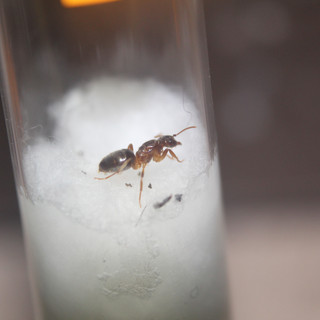
Here in Wisconsin, by October, most of the ants have disappeared. The carpenter ants are tucked into their galleries, the Lasius have pulled their brood and aphids deep underground, and the sidewalks that were covered in workers a month ago are mostly empty. If you flip a rock now, you'll often find a cold, sleepy gallery of ants that want nothing to do with you.
But there's one ant that's just getting started.
On a cold, gray day, sometimes with snow still on the ground, you can find small, shiny brown ants walking among the forest floor like it's the middle of June. That's Prenolepis imparis, better known as the winter ant (or the false honeypot ant). It's one of the strangest ants in North America, and it specializes in the time of the year that other ants avoid!
Where do ants go in the winter?
First, a little background. Most ants in places with cold winters go into diapause (a hibernation-like resting state) when it gets cold. The colony moves down below the frost line, the queen stops laying, and everyone waits it out. Ants are cold-blooded, so when it's cold, their whole body slows down. Foraging in the cold would burn energy they can't afford to waste, especially when there's no food out there to find.
That's why antkeepers hibernate a lot of species over the winter. We're copying what they'd be doing in the wild!
The winter ant flips the whole thing on its head, though.
An ant that loves the cold
Winter ants do most of their foraging when it's COLD. Back in 1930, William Morton Wheeler, one of the most famous myrmecologists of all time, wrote an entire paper on this species. In it, he quotes notes from an observer who found the workers most active outdoors between about 35°F and 55°F all winter long, and sometimes crawling over the soil below freezing.
Think about that for a second. Most ants won't even leave the nest until it's warm out, and these ants are out hunting for food at temperatures where you'd want a jacket and gloves!
So why would an ant do this? Well, if you're the only ant out foraging, you have no competition. Every bit of honeydew, every dead insect, every drop of tree sap is yours! While everyone else is asleep, the winter ant has the whole forest to itself.
In addition, they're very opportunistic. It's not uncommon to see them lapping at fallen, broken-open apples and other fruit, drinking up the juice and heading back to the nest with swollen gasters!
They sleep through the summer instead
If that's not strange enough, the summer gets even weirder. In the summer, when every other ant is out foraging, winter ants mostly disappear.
In 1987, Walter Tschinkel published a study where he dug up winter ant colonies in Florida to map out their nests and follow them through the year. He found that their nests are DEEP. The shallowest chambers were about 2 feet (60 cm) down, and some nests went as deep as 3.6 meters. That's nearly 12 feet underground, deeper than most basements!
During the hot months, the colony stays down there, where it's cool, and they mostly stop coming to the surface. It's basically hibernation in reverse. Scientists call it estivation (a summer resting period). Down in the cool soil, the queen lays her eggs and the workers raise the brood, then the colony comes back up when the weather cools off again. According to Tschinkel, in some of the lowest chambers in Florida, the nest stays between 61 and 75°F all year!
In more northern areas, it's not uncommon to find workers in the summer, too. However, these are mostly outlier, straggling foragers, not huge active colonies. As soon as it becomes cold, the colonies begin excavating again (you'll see a new ant hill pop up randomly, but they've been there all along!) and their activity levels skyrocket for weeks.
In the north, these ants do hibernate (diapause) during deep, very cold winter. However, in the fall and spring, those times when it's cold but not freezing, THAT is their main active period.
Workers that store food in their bodies (living refrigerators)
If you look closely at winter ant workers in the spring, some of them look like they've swallowed a balloon. Their gasters (the rear section of their body) get huge and stretched out, so much that you can see the light membranes between the plates. That's where the name "false honeypot ant" comes from!
For a long time, people thought these workers were storing liquid food in their stomachs, like true honeypot ants (Myrmecocystus) do. But Tschinkel's 1987 study found something different. Those swollen gasters are full of fat bodies (fat-storage tissue), not liquid. These "corpulent" workers are basically the colony's pantry. They pack on fat while food is plentiful in the cool months, so the colony can make it through the long, hot summer underground, when nobody's going out to forage.
So, not a true honeypot, but pretty close!
They have a chemical weapon
This one's my favorite. Winter ants are small and pretty calm, and they don't sting. You'd think they'd be easy pickings for an aggressive invasive ant. They're not!
In 2011, a team of researchers at Stanford, led by Trevor Sorrells and including the well-known ant biologist Deborah Gordon, studied what happens when winter ants come across invasive Argentine ants. Argentine ants have wiped out native ants all over California, but winter ants were still hanging on in some spots.
It turns out that when a winter ant gets into a fight, it can spray a white, oily liquid from the tip of its gaster. In one-on-one trials, 79% of the Argentine ants that got hit with it died within an hour. Most of them were immobilized almost immediately. The winter ants were also much more likely to use their weapon near their own nest, and when they were outnumbered.
A small, shy, cold-loving ant that can take down one of the most destructive invasive ants on the planet. How cool is that?
The first flights of the year
Winter ants are also some of the earliest ants to have nuptial flights (mating flights) each year. Wheeler's 1930 paper lists flights from mid-March into early April across the species' range. The winged queens and males are raised the summer before and wait in the nest all winter, so they're ready to go on the very first warm days of spring.
If you're an antkeeper itching for queens after a long winter, keep an eye out on warm spring afternoons! In my experience, it's often the first 'warm' day(s) of spring. Typically, air temperatures of above 65-70°F is the minimum to trigger flights. Sometimes, if it's a sunny day, they can be more encouraged at lower temperatures! Their orange queens in contrast to the dark workers are very notable, and can be found wandering the pavement, forest floor, and even lawns on those warm spring days for a few hours after they fly.
Can you keep winter ants?
You can, but I'll be honest, they're not the easiest species to keep. It's not that they're intense to keep, but more that they're finicky. They have a tendency to randomly drop dead if something is off, and their founding rates are usually pretty bad, with a lot of variation. They're an inconsistent, finicky species. They are pretty slow growers, but a great display colony. If you can get a good colony going, though, they're pretty cool looking!
If you want to try them, our Prenolepis imparis care sheet goes through everything you need to know. You can also join the waitlist for winter ants so you'll be the first to know when we have them again!
Quick facts about the winter ant
Scientific name: Prenolepis imparis
Common names: winter ant, false honeypot ant, false honey ant
Range: much of the United States, south into Mexico
Active: mostly in the cool months, even near freezing
Summer: colonies retreat deep underground (estivation)
Nest depth: up to about 12 feet (Tschinkel 1987) in Florida
Colony size: up to a few thousand workers
Special skills: fat-storing "corpulent" workers, and a chemical spray that kills Argentine ants
Next time you're out on a cold day and you see a few ants walking up a tree, or trailing to a stepped-on apple, take a closer look. It's possibly the winter ant, out doing its thing while everyone else is asleep!
Have you ever spotted winter ants out in the cold? Share your sightings with us on Discord!
References
Sorrells, T.R., Kuritzky, L.Y., Kauhanen, P.G., Fitzgerald, K., Sturgis, S.J., Chen, J., Dijamco, C.A., Basurto, K.N., and Gordon, D.M. (2011). Chemical defense by the native winter ant (Prenolepis imparis) against the invasive Argentine ant (Linepithema humile). PLoS ONE 6(4): e18717.
Tschinkel, W.R. (1987). Seasonal life history and nest architecture of a winter-active ant, Prenolepis imparis. Insectes Sociaux 34(3): 143-164.
Wheeler, W.M. (1930). The ant Prenolepis imparis Say. Annals of the Entomological Society of America 23: 1-26.
Williams, J.L., and LaPolla, J.S. (2016). Taxonomic revision and phylogeny of the ant genus Prenolepis (Hymenoptera: Formicidae). Zootaxa 4200: 201-258.


Comments